
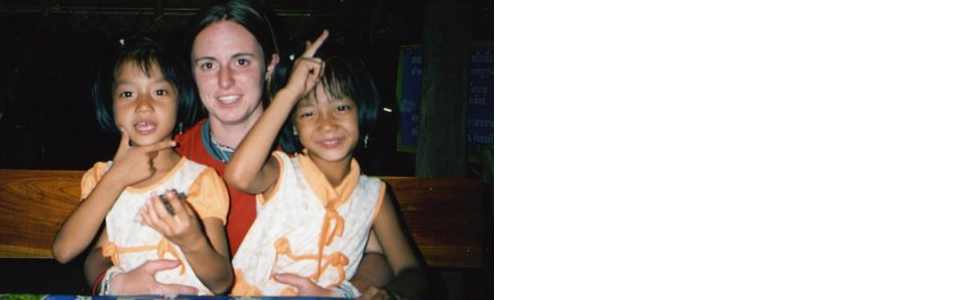

My life prior to that had been pretty geared towards sports, I was in the athletic training program. That's what I was gonna do. Went to Thailand, and athletic training all that was right out the window. Really opened my eyes to a bigger picture, and really allowed me to reflect on my own upbringing, really agricultural community and then to go to an agricultural community that was so different. Hanging out in a combine all harvest… So definitely academically, huge shift. Last couple years starting to talkwith Rob about where we can take the program. Being able to apply all those things you're seeing, all those questions.
The biggest thing it did for me was make me ask a lot of questions.
The community building aspect was huge. More and more, it's a really important aspect of this program. Not just going and seeing another culture and expanding your world view, but the community building that goes on within the team before you even leave. That's huge. Helps you making a conscious effort to build community. Then going somewhere where there is a much stronger sense of community.
I would say it felt more authentic. With Expedition Club the whole time you're working on that process, you're debriefing, you're coming together to talk about things. You're consciously building community that whole time. So I think you learn a lot more about what it takes to consciously build community, the work involved.
While I was there is was the rice harvesting season. That is a really amazing time to be in the village. Really cool to see the village in action. All the elder women come alive. My impression is that it's what they live for. I've never been so humbled in my life. They do it 7 days a week for the entire rice harvesting season. As somebody's fields are ready, they load everybody in and go for however many days it takes they finish harvesting.
What happens to those old women's roles in the village? They're not gonna be the ones driving the combines. What happens to the fabric of the community? Seeing that community based agriculture, was like wow. We can't tell them it's better this way," she recognizes, then adds laughing, "but, gosh, it's so much better this way! For me to see it full on, how can we not force our opinions on them, but how can we start to work with the village so they know this is unique and this is special. What do you lose when one person all this land that right now 50 people own? And how do find that balance between using the technology and keeping that communal? Big moment for me, and spoke to a lot of the stuff that Robbie and I had been talking about how do we move the program forward, what other things can we start to look at besides teaching English. What can we offer to them in exchange for letting us be here, and what can our kids learn. Taking it a step further.
It's crazy because you harvest and that night you're eating it. Growing up on the Palouse, we harvest our wheat and it's like, bub-bye. It's probably going to China.
The village has forced a lot of critical thinking, especially from the western stance. Looking back on my first year, there were no TVs really, there was that one landline, there was no internet. And now they have this block of computers in the school that they essentially won. There's internet. And it's a little bit hard to accept that. So it forces you to, it's making their lives better. Computers aren't bad unless you sit on it all day and don't talk to the people next to you. So it really makes you to think about development issues. Within a month it's like family. You're totally attached. To be that involved with a place forces you to think a little bit more critically about that stuff. And not just judge good/bad.
They're no longer the Other. That's something else that the program offers is discourse on the Other and development. Especially as you go back more and more, it doesn't just break down the dichotomy between you and the village. It starts to make it easier to identify and have compassion for the people that you read about. And it really helps break down that sense of the Other.
Now more than ever all this news about bullying. So all of a sudden that community building aspect is more important than ever. But also going to a culture where there is bullying, but it's not tolerated. You don't see bullying there to the extent that you do here. But if it does come up, they're on it. Learning the skills of compassion and being able to identify.
Seeing PT change a lot. It's gotten worse and it's gotten better. As kids come back, that helps. For while it's been a community that's not a community. I've seen a lot of selfishness, I've seen a lot of people stepping on other people. A lot of transient—people who are here for 2 months out of the year in their vacation homes. It has become a very sort of transient community. And yet everyone preaches that Port Townsend is such a strong community. But I feel in a lot of regards it isn't. And so I think that work that Rob's done with community building is evident to me that I see a stronger community and a stronger maturity in the young kids than in the adults to a certain extent. Which I think is kind of cool. I think it's make the young community in this town really strong. And I think it's important that they're support each other, especially with having people who're here only 2 months of the year and don't vote for education referendums or whatever.
Which is really similar to the village—there's that same demographic missing in the village. Part of her work in geography is going to be in rural and agrarian studies, the other in labor migration. A lot of the men leave to go work, and a lot of the kids are at school or they leave to go work. They either can't make money farming or they don't want to. In large part, a lot of people don't want to be a farmer. Start that dialog—how do they deal with it, how do they respond to it? How can you bring that demographic back—both here and in Phapang? What is bringing us back to Port Townsend? Can you look at something like that to bring people back to Phapang? A lot of kids it seems like are coming back here to do ag stuff. How can you find a spot for that demographic in the village? That's such a crucial age.
How can we move the Expedition Club forward? What issues do we want to address? What sorts of people do we want to bring to the table? Food and ag education kids come in. Progress is inevitable. I'm not saying that we know better than Phapang what Phapang needs, but we're much further down that road of messing up. We've made a lot of mistakes that they haven't made yet and I don't think they need to make. So working with them. Starting that dialog: here's what happened when we did that. It would be a great place for kids, both Thai and American—maybe more—to get hands-on experience in shaping that discourse on development and doing it sustainably and durably. I think it's an amazing opportunity for the program to head that direction. And I think Rob's an amazing teacher and I think his greatest skill as a teacher is curriculum design—getting the most out of the program and getting the most out of the kids, really pushing the kids to think critically and think outside the box. What would Ex Club be at it's best? I think that environment that's interdisciplinary, involving that demographic from Phapang, bringing them in. Taking their experience and our experience and looking at all sorts of issues. What issues are you facing?
That's globalization at its best to me. Globalization often get's touted as a bad thing, and if you leave it be it will be. If you use it to preserve and spread all cultures. You have to accept it's gonna happen.
It would be hard to open the floodgates. It's our family, so it's a little bit nerve-wracking. But I think looking at all the people who've been and what they're doing, especially from those first two years. Convince groups of them to come back. Kind of use them to lay that foundation. It's something I'd like to see. Fun to have an alumni group. Staying for a longer period of time.
It's definitely changed the nature of my travel. No matter what I'm traveling for, even if it's a vacation, I'm much more observant, much more analytical. It's much harder to vacation. I want to know how these people are living, I want to know what's going on behind the scenes.
Particularly if you go more than once, it can't help but shape your interest at least somewhat. It might influence how you apply those interests. It's definitely had a huge impact on the issues that I'm interested in pursuing.
Life would be so much easier if I'd just never gone to Phapang. It'd be so much more straightforward and simple—but so much less satisfying. I'm not saying that it's good or bad. For me, I've always wanted a life worth figuring out. When you do figure out those little things, you're so much stronger having gone through that process and having been forced to think about it critically. It's valuable. There's definitely something to be said for people who've had to figure their lives out. I think Phapang makes you do that. What's important to you. All of sudden what makes you happy changes. What the good life is. Before my experiences with Expedition Club and after my answers would have been very different.
A generation of kids who've had to think critically about their lives and about their place in the world and what's happening in the world. Raising a generation of critical thinkers is invaluable on all sorts of levels. Whether you realize it or not, Phapang kind of forces you to do that. Different for everyone.
What is your last moment in that village? You're balling. You're hanging out of the van windows reaching out to grab kids' hands. Every single person is balling. It's so hard. Leaving that village not knowing if you're gonna come back, and for them not knowing if we're gonna come back. Which especially with the economy, it is entirely plausible that one year we're not gonna be able to go back. It's by far one of the hardest things I've ever had to do. Yet you ask all these kids and you ask the people in Phapang and they're gonna tell you it's one of the greatest things in their life.
Walls get broken down that you don't really know are getting broken down. I know my first year it kind of caught me by surprise. It sorta happened to me while I wasn't paying attention. The day before, 'What just happened? I've only been here a month, and this is going to be so hard.'
Learning to have compassion, to relate to people whether it's brief or not, and then learning to let go and accept I might not be back.
Robbie talks a lot about compassion in the process of community building. It's not like the people of Phapang have some sort of compassion curriculum. They don't do it intentionally. Yet nowhere have I experienced it on that level. And you can't help but build that compassion while you're there.
A lot is happening without realizing it, which is sometime more valuable especially for teenagers. Your teachers and your parents are saying, 'You need to be more compassionate, you need to not bully kids, you need to respect your elders.' No one's necessarily tell you to do it, but those little everyday things start to build and a lot changes while you're not paying attention.
It goes back to asking questions. Kids asking, 'Why?' It's that observing and asking questions. You get to pursue your interests.
Money. There's no shortage of interest, although to plant interest is always good. Money's always the biggest issue and there's no profit being made monetarily speaking. Think of it as tuition. I learned so much more in my month there than I do in school. And it' paying the village back. The village has a lot of things; what they don't have a lot of is money. A lot of the money goes towards scholarships for the Thai kids. You can think of it as not only paying them back for teaching your kids, but also taking care of your kids. There's nowhere I feel safer, there's nowhere I feel more looked after. And the way that we can repay the village for teaching our kids about community and compassion is by continuing to go. And do what we can to help their kids get an education, and that happens via money and by having native English speakers. English is their key to getting into good schools. It's unexciting and not poetic, but money.
And showing interest, because this is something the kids get really passionate about. It's hard to come back and your parents are like, "How was it?" Kids probably shut down on you at that point. So when Ex Club has slideshows and storytelling and movies—come to them. Because so many kids are passionate about it, so dedicated to it, they work so hard and put so much time and energy into it. Money and interest. It means the world to put on a slideshow or a movie, to talk about the program, and have people show up. To know that people are interested and to be able to share that with everybody is huge, because there's so much that happens and it is so hard to say it in words. Come out and share that with them—and donate while you're there.